Those wishing to follow the route below should start in the morning, in comfortable outdoor gear, as the walk will be one of the longer ones – rich in sights though. Light footwear and a camera are obligatory!
The Buda Castle Quarter
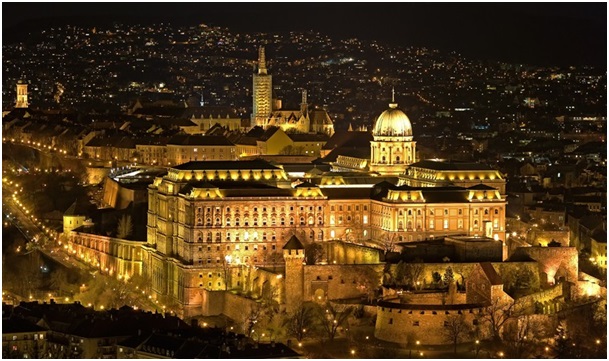
The Buda Castle Quarter is part of Budapest’s I District, although the average Hungarian just refers to it as “the Castle”. It was declared a UNESCO World Heritage Site in 1987. The District is home to several medieval monuments and residential houses and public buildings dating back to the 17-18 centuries. The Buda Castle Quarter is made up of three main parts, namely the Royal Palace, St. George’s Square and the historical residential quarter.
The foundations of the Castle were laid as early as 1243. And, although its construction coincided with the first Mongol invasion of Hungary, evidence suggests that it may have been ready by 1255 as one of King Béla IV’s charters makes reference to it as a fully constructed fortress.
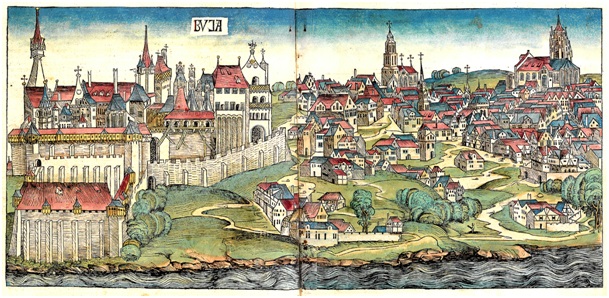
During the subsequent course of history, the area was subject to attack after attack and siege after siege, resulting in the repetitive destruction and reconstruction of certain parts of the District. World War II destroyed a significant part of the Royal palace and the Castle Quarter. Interestingly, reconstruction did not immediately start by rebuilding the walls; archeological explorations commenced instead. Then, most of the buildings were reconstructed in a fashion more or less resembling the original structures, with a smaller demolished or rebuilt with simplified façade designs.
Cars are not allowed to enter the area of the Castle Quarter, but since we started out to take a stroll, we may at most use some means of public transport. From the north, one can walk up to the Castle Quarter on foot or take buses 16, 16A and 116 from Széll Kálmán Square. An elevator and a footpath are available from Attila Street in the west, with further footpaths from the southern Tabán area and the Castle Hill Funicular in the east. Here again, an alternative footpath is also available, passing the Toldy Ferenc Grammar School, the University’s Catholic Grammar School and the Fisherman’s Bastion.
The Budapest Citadella
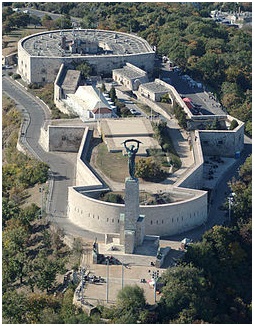
The Citadella is at the top of Gellért Hill. Originally the site of a watchtower in the Holy Roman era, legend has it that it was later a witches’ den, before becoming equally famous and notorious for being the place of Bishop’s Gellért’s martyrdom. Meaning of the word ‘Citadella’: citadel.
After the Siege of Buda in 1849, it was decided in the Bach-era by the council of war in Vienna that a system of fortresses that can be well defended needs to be built to replace the obsolete Buda Castle. Construction of the first fortress of the system commenced according to the plans of Austrian military engineer Emmanuel Zitta in 1850 and it was housing Austrian soldiers four short years later. The rest of the system was never built, as the Monarchy opted to build a modern system of fortresses around the city of Komárom instead.
In reality, the Citadella was not up to the requirements of modern warfare even at the time of its construction and the 220 m long, 60 m wide building with its 4 m high walls was rather serving to simply frighten the Hungarians. 60 cannons were installed here. After a lengthy chain of disputes, it was finally decided in the 1960s to convert it into a touristic centre. It offers a breathtaking view of the surrounding Budapest cityscape.
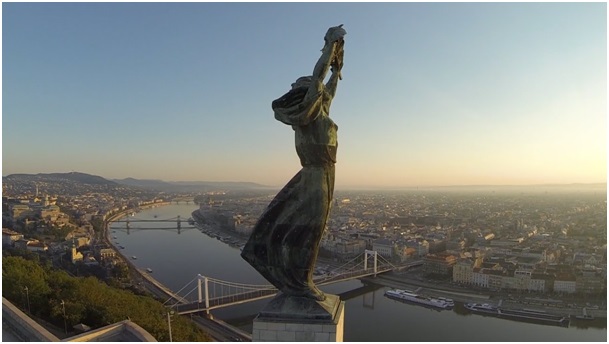
The Liberty Statue
The monument featuring a female figure holding a palm leaf in her upraised hands was designed by Zsigmond Kisfaludi Stróbl in 1947. It was first erected in 1947 in remembrance of what was then referred to as the Soviet liberation of Hungary during World War II: the military feat of the Soviet Army, ending the occupation by Nazi Germany. After the end of the socialist era and the revaluation of the so-called “Soviet liberation”, allusions to the Soviets were modified, among others by removing the 4 m high statue of a Soviet soldier from the foreground. The inscription on the foundation of the statue was also modified, giving a new meaning and role to one of Budapest’s most spectacular sights. The female figure symbolising liberty has become one of the city’s most important icons. The statue itself is 14 m tall, rising to a total height of 40 m on its foundation from the top of the 235 high Gellért Hill.
On foot from the Buda Castle, it is worth taking the footpath along the Danube embankment to the foot of Gellért Hill, from where a number of footpaths are available, all leading to the top. For those wishing to take the bus, hopping on no. 27 leaving from Móricz Zsigmond körtér is the simplest option.
When descending from Gellért Hill towards Elisabeth Bridge, and continuing straight to the Pest side across the bridge, we find our next stop:
The Synagogue
The Dohány Street Synagogue, also known as The Great Synagogue The stunning historical building is in Dohány Street, in the 7th district of Budapest. It is the largest synagogue in Europe and is a centre of Hungarian Neolog Judaism.
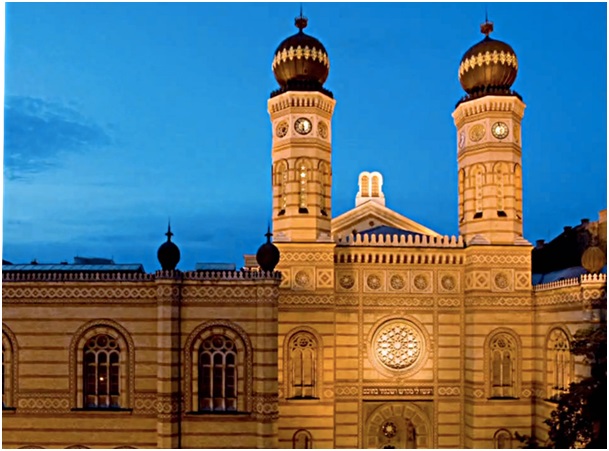
One and a half centuries ago, a tender was announced for building the synagogue, eventually awarded to Viennese architect Ludwig Förster, teacher of the Academy of Fine Arts in for his designs in the Moorish Revival style. Its construction was completed in a short five years, which was a record speed at the time.
As for its location, no miscalculations were made; the main entrance of the building is at an angle to the street on purpose: ancient regulations require that a synagogue’s façade must always face Jerusalem. The façade of the building is made of fired ceramic with limestone and occasional marble wall footing.
After having circled and marveled at the building and every corner of its garden within the fence, it is worth continuing down Dohány Street.
Dohány Street
Dohány Street is the most characteristic street of Budapest’s Jewish Quarter. Pest’s old Jewish quarter formed along the street leading to the Danube crossing in the 7th district of Budapest at the turn of the 18th and 19th centuries, its centre then being Király Street. In 1944, the site of the Jewish Ghetto was also designated here, with one gate at the Wesselényi Street side of the arcades. In 2002, the area bordered by Király Street – Csányi Street – Klauzál Square – Kisdiófa Street – Dohány Street – Károly Boulevard, i.e. the “Old Jewish Quarter” has been included in Budapest’s world heritage protected zone.
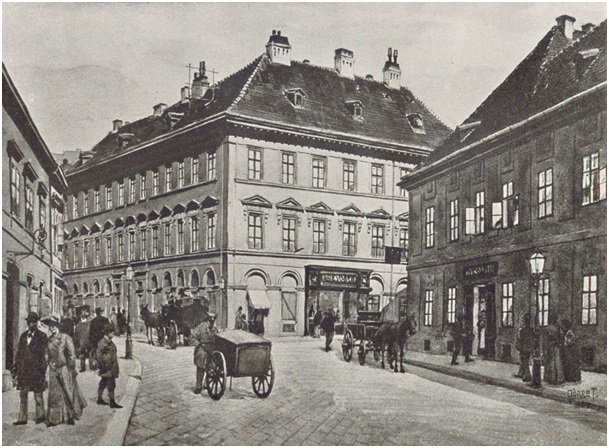
If you still have the strength, after a brief walk along Dohány Street the monumental building towering over the Grand Boulevard can already be spotted from a distance. This is none other than the
New York Palace
One of the most impressive buildings of the Grand Boulevard. The building, richly decorated with marble, fine gold leaf and frescos was always a centre of attraction for the public, as beauty is something everyone longs after.
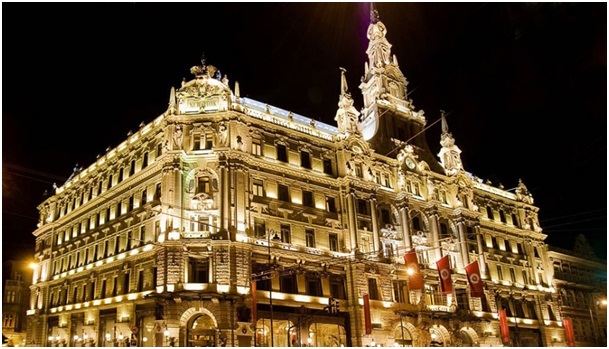
The complex, however, is not only beautiful; it holds its solid significance in educational history as well: the literary and artistic tables and café editorial offices formed in the 1900s at the New York Café went on to make Hungarian history along with the building, giving it literary significance besides its obvious architectural one. The building’s history has seen days of lustre, had its share of misfortune and deterioration, as well as a period of fundamental restart, sweeping away all remnants of the past. Some telling pieces of information are that it turns 123 this year and in 2011 it was awarded the “World’s most beautiful café” title at a prestigious international vote.
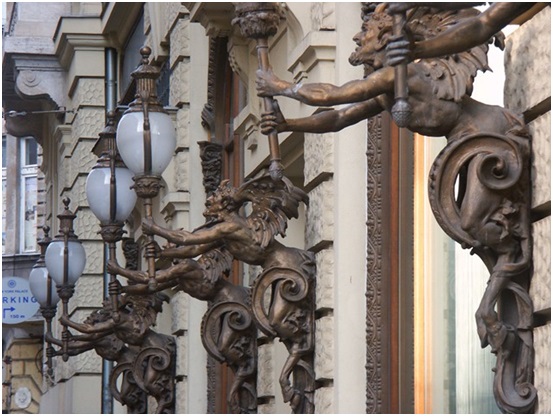
The palace was built by Alajos Hauszmann, on commission by the New York Life Insurance Company, and he then designed the four-storey eclectic palace with the café at its ground floor in cooperation with Flóris Korb and Kálmán Giergl, the building eventually opening for the public on 23 October 1894. The outdoor statues and decorative sculptures and the fourteen fauns crowning the café’s portal were made by Károly Senyey.
As we promised some special treats for today’s trip, it is now time to take a break and let our tired limbs rest.
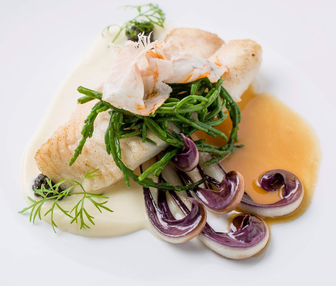
Not only the New York Café, the Salon Restaurant is also open for this. If you’re into fine dining, you could be in no better place. Meet the excellent compositions of Essential Hungarian Gastronomy, i.e. a menu largely based on traditional Hungarian courses combined with spectacular presentation in rethought form to please the contemporary gourmet.
The hungry visitor may choose from seven and four-course menus with vegetarian and fusion variations as well. Each menu is composed with elaborate care, accompanied with and made complete by appropriately selected beverages.
I’d like to reserve a table at the Salon Restaurant!